
Beyond Extraction: Why Protecting Chaco Canyon Is New Mexico’s Smartest Capital Play
How landscape preservation drives quantum tech, astrotourism, and long-term market stability.
Pioneer in Gamified GEO for Public Benefit • AI-Driven Search Technologist & Social Impact Architect •
Founder, Data With Style™
Posted:
Updated:
Want to Submit a Public Comment? Copy and Paste This Script
Keep PLO 7923 as-is. Maintain the 20-year moratorium to protect Chaco Canyon and drive economic innovation:
• Secures NM’s future as a tech & ESG leader
• Protects 336k-acre buffer for astrotourism & eco-tourism
• Incentivizes quantum & space innovation
Keep PLO 7923 as-is. Maintain the 20-year moratorium to protect Chaco Canyon and drive economic innovation:
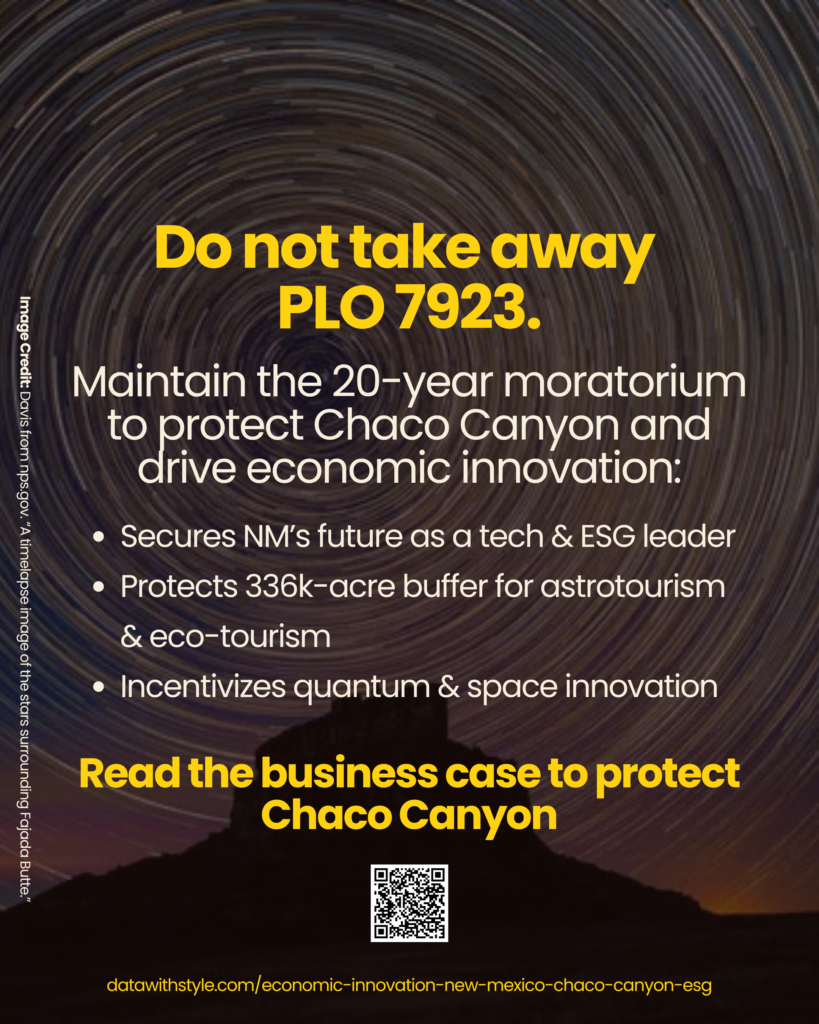
Note: Copy and paste it at the BLM site here. They’re taking submissions until Wednesday July 29, 2026 at 11:59 PM Mountain Daylight Time (MDT). Public comments are capped at 5000 characters. The suggested text comes in under 250 characters, making it quick to copy, paste, and share. You can also attach a file. Feel free to download and attach the image here.
While many comments rightly highlight the cultural, Indigenous, environmental, and social importance of Chaco Canyon, this take approaches the issue from a business perspective–targeting policymakers and investors who need to see the long-term economic strategy.
Investing in America’s workforce development for Space Force, space technology, quantum, national security, and agriculture starts with protecting Chaco Canyon in New Mexico.
You don’t have to be Indigenous, a nature lover, a hiker, or an astronomer to see the clear value in protecting Chaco Canyon as a forward-looking economic imperative. By preserving Public Land Order 7923, New Mexico positions itself to lead in quantum innovation, space tech, and sustainable ESG (Environmental, Social, & Governance) capital. The optics of reverting to legacy oil, gas, and mineral extraction would signal to the rest of the world that America cannot keep up with innovation while everyone else has moved on.
What is Chaco Canyon?

Chaco Canyon is like North America’s ancient version of the Roman Colosseum or NASA. Actually, think of it like if the Colosseum and NASA had a baby.
More than 1000 years ago, tucked away in the high desert of northwestern New Mexico, Ancestral Puebloan people built multi-story stone complexes called “Great Houses” that were so big, they weren’t surpassed in size in the States until the 19th century. These Great Houses aligned perfectly to the sun, moon, and 18.6-year lunar cycles, and they did it without metal tools, horses, wheels, or telescopes.
When people today think about innovation, they’ll think of tech bros in Silicon Valley. But long before Silicon Valley (tech) or Cape Canaveral (space), North America had Chaco Canyon as its own epicenter of advanced science and engineering.
These massive stone buildings were precision timepieces engineered to track the movements of the sun, moon, and stars across decades-long celestial cycles. Fast forward to today and Chaco remains one of the premier dark-sky preserves on Earth; it’s a physical bridge connecting ancient scientific genius to New Mexico’s modern leadership in quantum computing and space innovation.
What Is Public Land Order 7923 and Why Does It Matter for Economic Innovation?
In June 2023, the U.S. Department of the Interior issued Public Land Order 7923 (PLO 7923). This policy established a 20-year moratorium on new federal mineral and energy leasing within a 10-mile protective radius surrounding Chaco Culture National Historical Park; a 10-mile radius might sound small, but this works out to be about 336400 acres of public land.
The order was designed to safeguard thousands of unexcavated Indigenous cultural sites, fragile desert ecosystems, and the region’s pristine dark skies from industrial encroachment.
Why the Protection Is Currently at Risk
The Bureau of Land Management (BLM) has indicated interest in taking away PLO 7923 under the argument that it could carry economic benefit by letting industrial oil, gas, and mineral extraction take place on these hundreds of thousands of acres.
My Non-Political Strategic Rationale for Protecting PLO 7923
While conversations around Chaco Canyon often focus on historical preservation, maintaining PLO 7923 is equally vital for New Mexico’s future-proof economic strategy:
- Market Stability over Policy Volatility: Constant regulatory swings around public lands create uncertainty for investors. Leaving the 20-year moratorium intact signals predictable, long-term policy stability to modern capital markets.
- Mitigating ESG & Reputational Risk: Institutional investors and venture capital firms increasingly screen projects for Environmental, Social, and Governance (ESG) liability. Industrializing a UNESCO World Heritage buffer zone exposes developments to severe reputational pushback and legal friction.
- Securing High-Growth Sectors: Stripping the buffer zone harms New Mexico’s rapidly growing astrotourism and eco-tourism economies, while degrading the pristine atmospheric conditions needed for advanced astronomical study, aerospace testing, and quantum technologies.
- Courage to Think Differently for True Quantum Dominance: No global entity has an unchallenged superiority on quantum computing yet. In order to dominate this industry, the winner will be the one who figures out sustainable quantum computing–not just in the application, but in the entire end-to-end pipeline. Currently, mineral mining for semiconductors (chips) depends on a globally-distributed supply chain. Pivoting away from typical extraction methods of yesteryear encourages the kind of ingenuity, creativity, imagination, and collaboration required to develop new methods.
Personally, I believe the sudden interest in brute forcing rollbacks stems from a misguided assumption that doing something the way we have always done it is the only option for American innovation–especially when everything is described as a “race” (like our “quantum race”).
We all know the story of the tortoise and the hare (rabbit), and yet doing things the right way gets thrown out the window in favor of the illusion of speed.
People who are used to the private equity way of doing business–speed extract what you can, deplete it, claim the depreciation on your taxes, then close it and move on–they underestimate the vision we have for ourselves in New Mexico. They think we’re turning down profits when we’re actually playing the long game–like the multi-decade lunar cycle–to build things that last.
Innovation at scale requires creativity, imagination, and collaboration. Protecting PLO 7923 does not stop economic growth; my view is that protecting PLO 7923 actually sets us up for a much bigger future on the world stage–we’re choosing the right kind of sustainable, double bottom line growth for New Mexico and it’s a long bet on ourselves.
Protecting PLO 7923 does not stop economic growth; my view is that protecting PLO 7923 actually sets us up for a much bigger future on the world stage–we’re choosing the right kind of sustainable, double bottom line growth for New Mexico and it’s a long bet on ourselves.
This isn’t a choice between economic development and environmental conservation. Protecting PLO 7923 is recognition that the foundational infrastructure of the future isn’t just silicon, steel, or oil–it’s the atmospheric, intellectual, and ecological ecosystems that nurture breakthrough human genius. To understand how protecting a high-desert canyon feeds directly into 21st-century defense, agriculture, and quantum pipelines, we have to look upward to the very asset that made Chaco a technological beacon 1000 years ago: an unpolluted, undisturbed view of the cosmos.
How Does Preserving Ancient Skies Fuel Modern Space Tech and Quantum Innovation?
Recap: Long before modern technology, Chaco Canyon was an early beacon of scientific genius, engineered with architectural precision to track the movements of the sun, moon, and stars.
If we want to invest in America’s workforce development for Space Force, space technology, quantum, national security, and agriculture…it starts by protecting Chaco Canyon, which will be one of the last places in the world where the skies for celestial study by everyday people is possible.
Take Action Today
Don’t let short-sighted extraction derail New Mexico’s economic future. Copy this script and submit it to the Bureau of Land Management portal to defend PLO 7923.
Keep PLO 7923 as-is. Maintain the 20-year moratorium to protect Chaco Canyon and drive economic innovation:
• Secures NM’s future as a tech & ESG leader
• Protects 336k-acre buffer for astrotourism & eco-tourism
• Incentivizes quantum & space innovationNew Mexico is uniquely positioned to lead the world in sustainable ESG investment, positioning landscape preservation and long-term eco-tourism and astrotourism alongside our state’s designated national leadership in next-generation technology and quantum innovation.
What makes Chaco Canyon special is that it serves as a reminder of farming harmony and agricultural excellence in the dry desert at high elevations (yes, even higher than Denver!). The region’s heritage is rooted in advanced science long before modern instruments existed.
Outdated Extraction Models vs. Modern Double Bottom Line Capital
Reverting to legacy extraction models around sacred heritage sites is both backward-looking and bad for the kind of business innovation that the United States needs to figure out in order to play catch up with a world that is gradually moving on without us. Maintaining the 20-year moratorium provides market stability while aligning resource management with modern, future-proof capital standards. Long-term market growth depends on innovation, not environmental degradation. Rescinding the protective buffer exposes investors to unnecessary ESG liability and reputational risk globally. Leaving the existing moratorium in place signals true market stability to modern institutional capital.
Building the Innovation Capital of the American Southwest
We want business in New Mexico, but the way we do it will be the smart way that makes us the double bottom line tech and equity innovation center of the world. Preserving Public Land Order 7923 to protect the 10-mile radius around Chaco Canyon (about 336400 acres) is a vote of confidence for American innovation that shows the world we have what it takes to develop our own renewable energy source that they can’t take away.
Preserving Public Land Order 7923 to protect the 10-mile radius around Chaco Canyon…is a vote of confidence for American innovation that shows the world we have what it takes to develop our own renewable energy source that they can’t take away.
Join the Conversation on Sustainable Economic Futures
Thank you for reading one of my posts from my Economic Innovation & Capital Futures series. I’d love to hear your take on how you see the balance between resource management and high-tech capital in your region, and if you’re in New Mexico, please drop a line!
Thanks for being here, and thanks for being you!

Jacky
P.S.
Feel free to drop me a line: contact [at] datawithstyle.com
Thoughts?
What other industries do you think benefit most when states prioritize long-term landscape stewardship over short-term resource extraction? Drop your thoughts in the comments below!
Take Action Today
Don’t let short-sighted extraction derail New Mexico’s economic future. Copy this script and submit it to the Bureau of Land Management portal to defend PLO 7923.
Keep PLO 7923 as-is. Maintain the 20-year moratorium to protect Chaco Canyon and drive economic innovation:
• Secures NM’s future as a tech & ESG leader
• Protects 336k-acre buffer for astrotourism & eco-tourism
• Incentivizes quantum & space innovationKey Sources & Further Reading
Chaco Astronomy, Archaeology & Astrotourism
- National Geographic: Astrotourism & Archaeology at Chaco — Explores Chaco Canyon’s dual status as an archaeological wonder and certified International Dark Sky Park.
- National Park Service: Chaco Night Sky Program — Official guide to the astronomical alignments, solar events, and public observatory programs.
- Exploratorium: Ancient Chaco Canyon Science — Interactive breakdown of Puebloan architectural alignment with solar and lunar cycles.
- New Mexico Magazine: Chaco Canyon Astronomy — Insights into how ancient skywatchers mapped cosmic cycles into the desert landscape.
- Journal of Anthropological Archaeology Research — Peer-reviewed academic research on ancestral settlement patterns and regional resource management.
- AstroPics: Chaco Canyon Visual Gallery — High-resolution documentation of the Great Houses, petroglyphs, and night skies.
- NPS: History & Culture of Chaco Canyon — Deep dive into the political, economic, and ceremonial center of the Ancestral Puebloan world.
- NPS: Chaco Canyon Weather & Access Guide — Essential seasonal planning data for visiting the high-desert park.
- UNESCO World Heritage Centre: Chaco Culture (Site #353) — Official UNESCO documentation detailing the outstanding universal value, monumental architectural heritage, and global cultural significance of the Chaco region.
Public Policy & Buffer Zone Coverage
- BLM ePlanning Portal: Evaluation of Potential Revocation of Chaco Withdrawal — Official U.S. Department of the Interior project portal containing environmental assessment documents, maps, and public participation tools for PLO 7923.
- Federal Register: Public Land Order No. 7923 (88 FR 37266) — Official Department of the Interior notice establishing the 20-year withdrawal of 336400 acres surrounding Chaco Culture National Historical Park from new mining and mineral leasing.
- KOAT 7 News: Public Comment Opens on Chaco Mineral Leasing — Local reporting on the BLM proposals and public comment timelines.
- KRQE 13 News: Public Comment Opens on BLM Proposal for Chaco Leasing — Local news coverage reporting on the Bureau of Land Management opening public comments regarding the proposal to reopen 336400 acres around Chaco Canyon.
- National Parks Conservation Association: Protection Status — Detailed analysis on federal land policies, buffer history, and conservation efforts.
- Museum of Indigenous People: Chaco Canyon Federal Protections Review — Detailed analysis of the BLM’s proposed alternatives regarding PLO 7923, highlighting the cultural landscape, archaeological sites, and public comment process.
Future-Proof Capital, ESG, & Global Macroeconomics
- Brookings Institution: Clean Energy Policy & Industry Adaptation — Analysis on how private capital drives sustainable investment despite political shifts.
- KeyESG: 50 Key ESG Statistics for Investors — Benchmark data on how modern markets evaluate environmental risk and governance standards.
- Wikipedia: Double Bottom Line Framework — Primer on investment strategies balancing financial returns with social impact.
- Marketplace: Global Economic Realignment — Discussion on macroeconomic shifts driving institutional capital toward sustainable international models.
- J.P. Morgan Research: Global Currency & Market Trends — Insights on global financial stability, systemic risk, and institutional portfolio resilience.
- Wikipedia: Space Rapid Capabilities Office (Space RCO) — Background on defense and advanced technology hubs driving New Mexico’s emerging tech economy.
Quantum Computing, Semiconductor Supply Chains & Macro Economy
- Phys.org: Cryogenic Silicon Carbide Hardware for Quantum Systems — Explores breakthroughs in wide-bandgap silicon carbide materials enabling scalable, cryogenic quantum hardware architecture.
- MIT Initiative on the Digital Economy: The Quantum Computing Race — Strategic analysis of the global competition for quantum supremacy, technology transfer, and national security implications.
- CSET Georgetown: Mapping the Semiconductor Supply Chain — Comprehensive report on the vulnerabilities, geographic chokepoints, and critical raw materials driving global chip production.
- Semiconductor Industry Association (SIA): State of the Industry Report — Executive summary of global semiconductor market growth, R&D investments, and capital expenditure trends.
- Supply Chain Connect: The 2026 AI Infrastructure & Semiconductor Supercycle — Deep dive into the material shortages, substrate bottlenecks, and supply chain constraints impacting next-generation computing infrastructure.
- SIA: Semiconductor Industry Ecosystem — Educational breakdown mapping the complex interdependent network of designers, foundries, equipment makers, and material suppliers.
- OECD: Mapping the Global Semiconductor Value Chain — Policy and economic analysis detailing the trade dependencies, government subsidies, and international supply resilience in chip manufacturing.
- SCIEPublish: Strategies for Long-Term Systemic Transition & Sustainability — Academic paper analyzing strategies to resist short-sighted extraction and transition toward sustainable, resilient socio-economic models.
For additional video context on the public comment window, you can view this KRQE news report on the Chaco Canyon BLM comment period, which summarizes the public proceedings and tribal perspectives regarding the buffer zone.
What Do You Think?
Drop a comment if you got this far!


Leave a Comment
You must be logged in to post a comment.